Straight Course or Turning Track? Reading the Course Plan
Straight course or turning track: learn to read a racecourse plan, identify the start and bends, and follow how the route shapes runners’ choices.
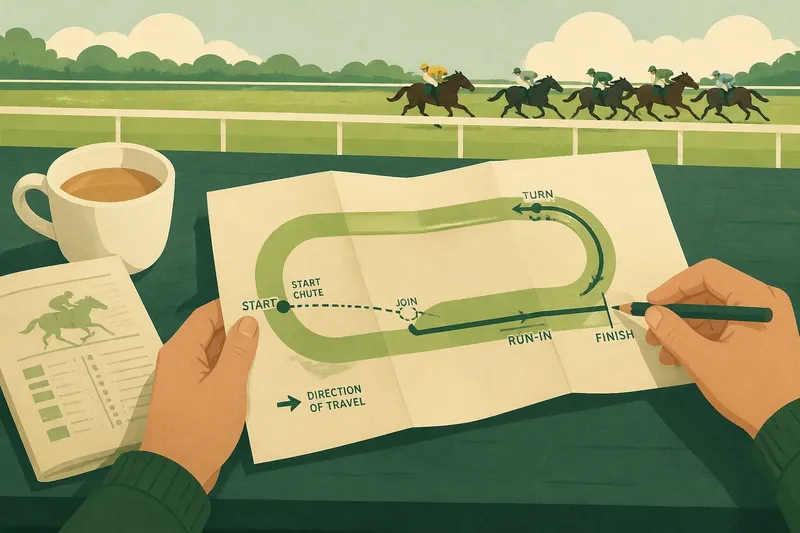
A folded racecard sits beside a cup of tea, its little course diagram easy to mistake for decoration. Reading a straight course or turning track begins by treating that diagram as a route map: follow the marked start to the finish, then notice where the ground asks runners to change direction.
Read the course map
A course plan is a simplified view of the racing surface, not a picture of the view from the stands. Find the start marker for the race, the direction of travel and the finish line. If the plan shows several starts or tracks, match the race details to the correct route before drawing conclusions.
A straight course carries runners along a direct route, though it may curve gently or vary in width. A turning track takes them around one or more bends. These labels describe the route rather than the race distance: a short race can include a turn, while a longer one can use a straight.
Plans may include turf and all-weather layouts, chutes that join the circuit, or more than one finishing straight. Check the surface and start point shown for the race. The diagram may also indicate whether the circuit turns clockwise or anti-clockwise, which tells you the direction of its bends.
Straight-course features
On a straight course, runners do not have to negotiate a major turn during the race. The route is usually easier to trace from start to finish, but that does not mean every runner follows the same line. The field may spread across the track or gather on one side, and the plan alone cannot tell you which pattern will develop.
Track width, camber and the position of the finish still matter. A broad course can leave room for different lines; a narrower one can keep runners closer together. When following a race, watch how the field uses the available space rather than assuming that a straight route makes positioning irrelevant.
Turning-track features
A bend changes the route’s geometry. Runners on the inside follow a tighter arc than those farther out, and the field may compress as it turns. Their position on approach can affect the space available, while the exit from the bend determines how directly they can move towards the finish.
The order of the route gives a useful viewing structure: approach, turn, exit and run-in. On a plan, compare the start marker with the first bend. A turn soon after the start leaves less straight track before the field changes direction; a longer approach gives runners more room before that point.
Do not assume that all turning tracks create the same demands. The number and placement of bends, the course width and the length of the run-in all alter the route. Trace the whole marked course, since a race may pass a bend more than once.
Plan-reading decisions
- Start marker: Check whether the race starts on the circuit or a chute. If it begins on a chute, trace where it joins the main track; otherwise, follow the circuit from the marked start.
- First bend: Observe how soon the route turns after the start. If the bend comes quickly, expect the field to change direction early; if it is farther away, note the longer approach before the turn.
- Number of bends: Trace the complete race route and count each turn it uses. If the route revisits a bend, include it in your sequence; if not, follow the remaining route towards the finish.
- Finishing straight: Check whether the final bend is followed by a straight run to the line. If so, mark where that run begins; if another turn remains, keep following the plan rather than treating the earlier straight as the finish approach.
- Track direction: Look for the direction of travel around the circuit. If it is marked, use it to follow the bends in order; if it is not, rely on the arrows or route line and avoid guessing from the venue name.
- Surface and layout: Match the plan’s surface and track to the race details. If they do not match, find the correct layout before reading the route; if they do, trace the marked start and finish.
Say you have an invented plan showing a race beginning on a short chute, joining the circuit, turning once and then reaching a long finishing straight. First, you match the plan to the race details and confirm the chute is the start; next, you follow its line to the join and mark the single bend; finally, you trace from the bend to the finish. The resulting route is chute, join, turn, run-in, so you can watch for the field’s position as it enters the bend and then follow its movement along the straight. This describes where to look, not who will finish ahead.
Questions about course layouts?
Which layout is easier to follow?
A straight course is often simpler to trace because the route has no major turn. A turning track becomes clear when you mark the start, bends and finish in order.
Does a bend decide the race?
No. A bend shapes the route and can affect positioning, but the result also depends on how the race develops and what happens over the remaining course.
Can one venue have different layouts?
Yes. A racecourse may use different tracks, surfaces, starts or routes. Match the plan to the details of the particular race rather than relying on the venue name alone.
What should I watch during the race?
On a straight, watch how the field spreads and uses the available lines. On a turning track, note the positions as runners approach and leave the bend, then follow the route to the finish.
For a straight course or turning track, the most useful distinction is the sequence of ground the runners must cover, not a simple claim that one layout is easier. A correctly matched plan lets you follow that sequence and know where a change of direction—or the final run to the line—begins.